Aboriginal Title vs Fee Simple Interest in Canada
What it all means

👋 Hey, Stefan here. Welcome to The Open House newsletter. I share news about presales, market updates and changes in your community to help keep you in the know. Have questions? Feel free to reach out any time!
stefan@local.group - 604.600.7217
I will preface this by stating that this issue, of course, goes deeper than just individual property rights, but as this is a Real Estate related newsletter, that is what we will be focusing on.
After five years of court proceedings behind closed doors, a recent ruling in August of 2025 awarded the Cowichan First Nations their claim to Aboriginal Title over a portion of land in Richmond, BC. This came as a surprise to most people (especially the private residents and land owners of the territory) and has raised many eyebrows, created unrest, enabled political platforming, and left most people scratching their heads as to what this all means moving forward. I thought I would delve into it a little further to see if I could make any sense of where we’re at.
What Happened
Before 1846 (when the colonies of Vancouver Island and British Columbia were formed), the Cowichan First Nations would travel by canoe from their homes on what is now Vancouver Island to the green area outlined on the map below during the summers to hunt, fish, and trade with other First Nations tribes further inland. The court case was brought by the Cowichan First Nations in 2019 as an attempt to regain control and title over the land they had once seasonally inhabited. To do so, they had to prove they had full control and exclusivity over this area of land. They did so by documenting that the Cowichan physically occupied the land through the construction of permanent structures and were able to maintain control over these lands even when they were not occupying them through intimidation, force, and other ruthless measures.
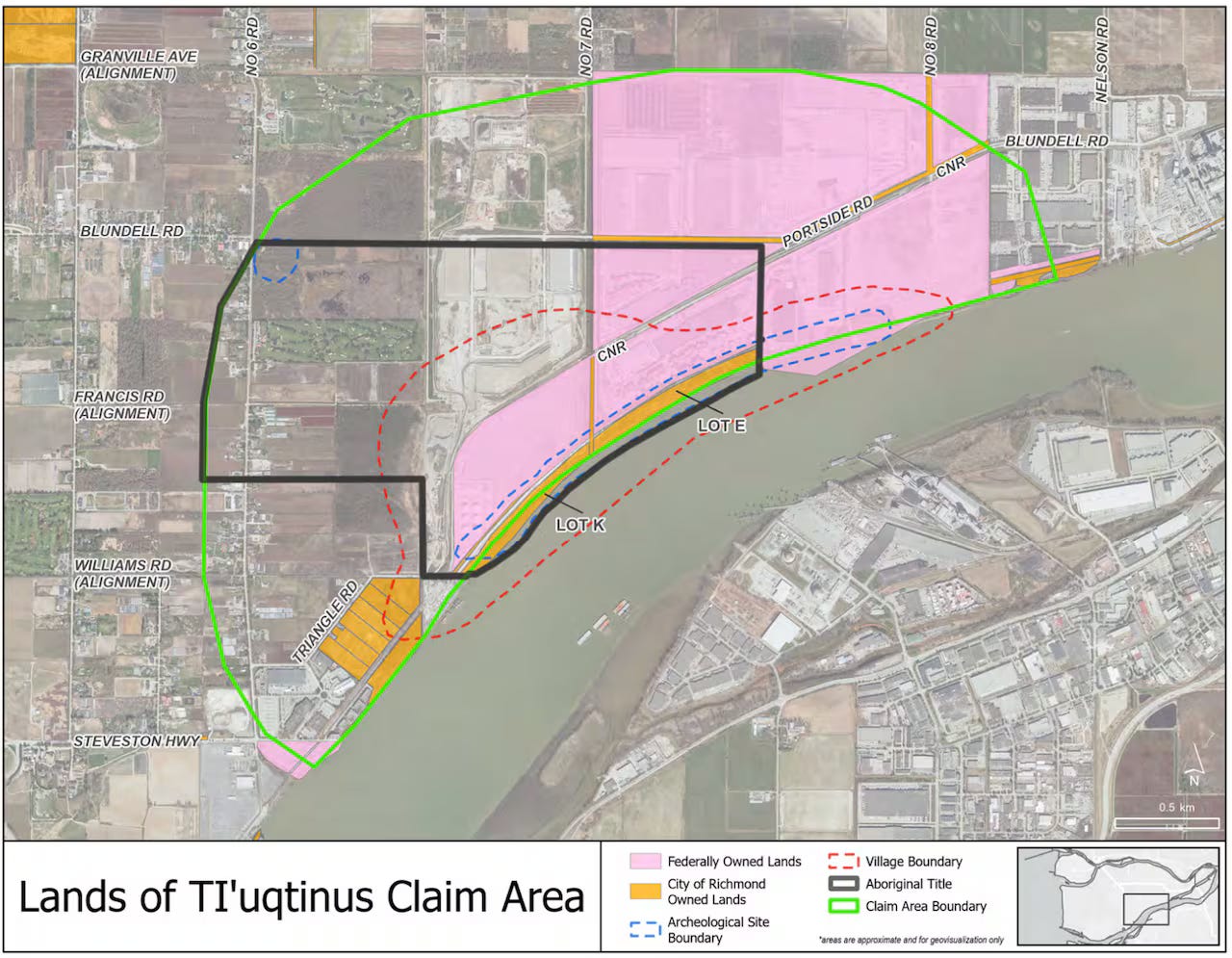
In August of this year, BC Supreme Court Judge Barbra Young ruled in favour of the Cowichan First Nations and awarded them Aboriginal Title over the area outlined in black on the map above (an area with a land value estimated at around $500 million). This area includes federal and municipal government land as well as privately owned commercial and residential property.
It’s important to note, from the interviews I have watched with members of the Cowichan and other First Nations groups, allegedly they only wanted to be awarded Aboriginal Title over the municipal and Crown lands (outlined in pink and orange in the map above) but instead (and I believe to their surprise) the judge awarded them full Aboriginal Title over all lands within the black boundary (including privately owned lands in fee simple).
Because of the potential threat to private property rights in BC and the precedent this case would set moving forward, the case has since been appealed by the defendants (the Government of Canada, the Government of BC, the City of Richmond, the Musqueam First Nations and the Tsawwassen First Nations) and I believe is currently awaiting a court date.
Why is it important
It’s important because the majority of land in BC (roughly 90%) is unceded land with no official treaties in place. In short, if the court of appeals upholds this ruling, the rest of BC may be subject to similar treatment if Aboriginal Title can be proven.
Residents of the affected area in Richmond are still in disbelief as this ruling came as a shock to them in August of this year. Very few of them even knew that the court case was proceeding, as no notification was given that their privately held land was being called into question as part of a civil lawsuit. In a recent interview, David Eby (Premier of BC) was asked why private land owners were not informed that the outcome of this case could have potentially grave implications for their property rights, to which he answered, “the court and the prosecution promised that private land owners wouldn’t be affected…unfortunately, it looks like that isn’t the case.”
Two other ongoing cases have recently been brought into the limelight (outlined below) as the issue has garnered major attention and reaction throughout the Province.
Tk’emlúps te Secwépemc First Nation filed a civil claim in the BC Supreme Court
In light of recent events, more Aboriginal Title claims are being brought to the public’s attention in ongoing court cases. Just last week Elenore Sturko, the independent MLA for the riding of Surrey-Cloverdale, brought to light the Secwepemc First Nation has been in a civil suit to claim title over the entirety of the City of Kamloops, several other municipalities, Sun Peaks Resort, roads, railways, and privately owned tenures of many types — including fee simple grants, mineral tenures, and many other Crown-granted interests. This has been ongoing since 2015 in response to prevent the operations of the Ajax copper and gold mine near Kamloops, alleging it would violate their Indigenous rights, desecrate sacred lands, and cause environmental harm.
Wolastoqey Nations New Brunswick Aboriginal Title claim
A 2021 lawsuit filed by the six Wolastoqey Nations seeking a declaration of Aboriginal Title over more than half the province, a claim that includes lands held privately and by the Crown. The claim is based on the argument that their ancestral title was never extinguished and continues to exist today. The case has been ongoing, with recent developments including court rulings that struck down certain claims against private companies, stating the case should be brought against the Crown, not individual fee simple landowners.
What the ruling means to fee simple owners of private land
As I mentioned before, these First Nations groups insist that even though the land they seek to reclaim encompasses privately held land owned by individuals in fee simple, they are not seeking to infringe on individual property rights and that their ownership status will not change. The unfortunate part is that the court ruling offers no legal protection for privately held land owners against the overarching Aboriginal Title claim.
Aboriginal Title and fee simple ownership are both exclusive forms of ownership and, by law, cannot legally exist simultaneously on title. The issue gets pushed even further when you read the ruling documents from the Cowichan case, which I will outline and link below.
Two details in the executive summary for the Cowichan ruling caught my attention:
• The Province has no jurisdiction to extinguish Aboriginal Title. The Crown grants of fee simple interest did not displace or extinguish the Cowichan’s Aboriginal Title (at paras. 2188–2190).
• Aboriginal Title lies beyond the land title system in British Columbia. Sections 23 and 25 of the Land Title Act, R.S.B.C. 1996, c. 250, do not apply to Aboriginal Titles. Accordingly, Richmond’s reliance on ss. 23 and 25 as a statutory defence is not made out. Richmond’s fee simple interests in the Cowichan Title lands are not conclusive evidence that Richmond is indefeasibly entitled to that land as against the Cowichan as Aboriginal Title holders (at paras. 2258–2262).
You can read the full court ruling HERE.
For reference here are the shortened versions of sections 23 and 25 of the Land Title Act:
Section 23 - An indefeasible title, as long as it remains in force and uncancelled, is conclusive evidence at law and in equity, as against the Crown and all other persons, that the person named in the title as registered owner is indefeasibly entitled to an estate in fee simple to the land described in the indefeasible title.
Section 25 - An action of ejectment or other action for the recovery of land for which an indefeasible title has been registered must not be commenced or maintained against the registered owner named in the indefeasible title.
You can read the full Land Title Act HERE.
The ruling creates significant uncertainty as to what the future holds for Fee Simple owners. If sections 23 and 25 of the Land Title Act do not apply to Aboriginal Title and Aboriginal Title trumps all other forms of ownership, what does this mean for fee simple owners?
The big unanswered questions:
How will this ruling affect land owners with a mortgage on title?
Now that they are (potentially) no longer in control of the land, can the mortgage be renewed?
What lender would grant a mortgage with Aboriginal Title superseding fee simple ownership?
Who would buy a property with Aboriginal Title? What would you actually own?
What is being done to rectify the situation while the court case gets appealed (which could take years)?
Who is footing the bill for all of this? If a settlement is reached out of court, where is the money for the payout coming from?
Here is a great interview with Professor Dwight Newman (Law Professor at the University of Saskatchewan) and lawyer Tom Isaac (Aboriginal Law expert) discussing the matter and what is at stake due to the nature of the ruling.
Listing of the Week
315 BAYVIEW ROAD, Lions Bay, WV - 3 Bed / 2 bath - 1773sqft - $1,748,000
Charming Post and Beam Coastal Cottage with gorgeous Ocean Views! Enjoy one level living with expansive decks and patios perfect for outdoor entertaining! This 3 bedroom rancher also comes with an office area, and a separate studio space. A new heat pump adds wonderful cooling on warm summer days to keep you comfortable and a WETT certified wood stove is perfect for cool nights. Newer septic system installed. The layout is perfect for artists, musicians, or for those who work from home. Gorgeous vaulted ceilings with exposed beams add to the character of this home on this beautifully landscaped, private .26 acre lot. Located close to the Village store, library, and post boxes. Lions Bay is a lovely community and offers a wonderful West Coast lifestyle! Have your agent set up a showing!


Got questions? Comments?
Leave them below or get in touch!
stefan@local.group
604.600.7217